

01 The premise
What this server is for
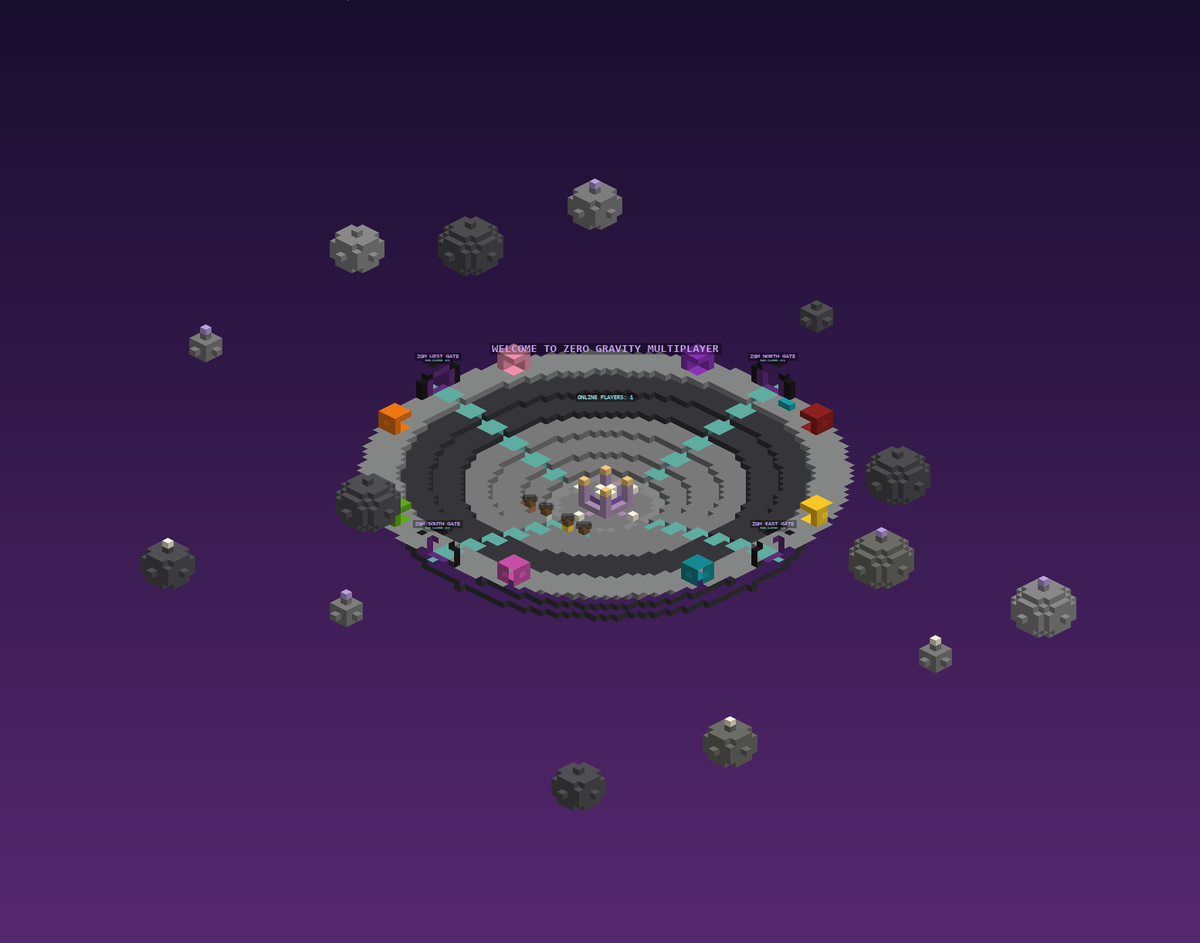
ZGMC is one void map, 2048 blocks across, with sixteen pads on it, four gateways into the lobby, twelve islands of ore, and one dragon that has not been given a fight yet. Every player starts with the same five items, and everybody's dirt is the same nine blocks.
That last part is the point. There is no shop, no economy, no ranks, no claims and no PvP. The only thing that makes one session different from another is who else is on the map while you are — so the alpha is not really testing survival, which is solved. It is testing whether sixteen people who each start with almost nothing end up with a place, or with sixteen private islands that happen to share an address.
So the primary focus here is not a grind and not a minigame. It is: build a home you keep, earn the ground under it, and do that in a world small enough that your neighbours are part of the result. If you want a single-player skyblock, the mechanics are identical and you will be missing the half that this server exists for.
Small on purpose
Sixteen pads and sixteen whitelist slots. That is not a queue or a soft launch limit — it is the scale at which everyone is still reachable. A pad is never released by dying, logging out or a reload, so a slot taken is a slot; if you move on, say so in the Discord and it can go to somebody else.
02 The shape of a run
The loop you are in
The mechanics are the world guide's job. The short version of what you will actually be doing, in order:
- Land on a pad in one of the four quadrants, take the kit, and read the sign with your site number on it.
- Make wood, then stone. Punch the tree, plant what it drops, pour the lava and put water on it. The first axe is the first real milestone.
- Build out, not down. The pad is a floor and a budget, not a quarry.
- Bridge to an island — 96 to 180 blocks — and mine the two ores it carries. All twelve refill on their own timers.
- Earn keys from what you mine rather than from a menu, then open the crate that matches the key.
Everything after that is the part the alpha has not finished: the diamond key wants a dragon kill, and the fight is not built. Two gold keys at the Exchanger will get you one anyway, at a price. Which is exactly why the rest of this page is about the other players — at this stage, they are the content that ships.
03 Who is next to you
Your nearest neighbour
Pads are not scattered at random. They sit on a jittered lattice with a hard minimum of 128 blocks between any two, and the cell is 256 with ±64 of jitter, so your nearest neighbour is somewhere between 128 and roughly 384 blocks away. 128 is not an accident: it is a few stacks of cobblestone, deliberately reachable without being on top of you. The lattice fills from the middle outward, so early on you are close to people, and the map gets less lonely before it gets more crowded.
The bridge is the road
There is no path to anywhere, so the first player to bridge to an island builds the route the next player will follow. A bridge with torches on it and a sign at the junction is public infrastructure, and it costs you a stack of cobble you were going to spend anyway. Two habits keep that from turning into a mess: do not bridge through somebody's pad, and do not build on top of a route that already exists — build beside it.
Unlit floor is spawnable floor, so a long unlit bridge accumulates mobs at the far end. A row of torches every few blocks is cheaper than the fight you would otherwise have on the way home.
05 Paying it forward
Somebody else's first hour
A new arrival is easy to spot: a bare 3×3 with one sapling on it, no roof, no torch, and five items in an otherwise empty inventory. The gateways are one-way, so the thing they most need is usually not an item at all — it is the two facts nobody reads on the way in.
- The gates only run lobby to pad. The way back is
/lobby, and it costs nothing. - There is a copper key already waiting. It was paid when the pad was recorded, so their first crate opening needs no mining.
Then the useful gifts, in order: a stack of cobble, a couple of torches, food, a sapling or two. Say what you are doing before you do it — a stranger placing blocks on somebody's only nine blocks of dirt reads as an attack until it has been explained.
What does not help, however kind it feels: building on their pad uninvited, mining the tree they just planted, taking their dirt for your own project, or dropping a pile of items at their feet while they are mid-jump into the void — items despawn, and a full inventory cannot pick them up anyway. A bridge to the nearest island, walked once with them, beats every item in this section.
06 Cooperation
Things that need two people
The void generates no structures, so every landmark in it is somebody's work. That is a good argument for building things that are useful to more than one person:
- A lit causeway to a deposit. One player places, one lights. It turns a 180-block bridge into a road, and every later trip uses it.
- A junction marker. A pillar, an arch, a sign with a direction and a distance. Navigation in a featureless void is the first thing players get wrong.
- A shared farm or furnace bank. Anything with a door people can walk through without asking, on the understanding that it is restocked by whoever uses it.
- A base for more than one player. Nothing stops two pads from growing toward each other until the 128 blocks between them are a street. It is the closest this map has to a settlement.
The lobby is adventure mode inside a barrier shell, so it is not a place to build a notice board or leave a chest — shared things live in the void or in the Discord. Plans that outlast a session belong in the Discord too; in-game chat is where the next ten minutes get arranged.
And the honest caveat: the map is disposable. Growing from sixteen pads to thirty-two is a wipe and a regenerate, announced in advance. Build a street before you build a cathedral.
07 Help
Who to ask, and what they can do
One door: the ZGMC Discord. Applications are read there, bugs are read there, and “is this a bug or is this the game” is the most useful question anybody brings. Before you post, the world guide's symptom table covers most of what looks broken and is the game doing what it was told.
| What happened | Where | What helps |
|---|---|---|
| I cannot connect | Discord | Your edition and the exact error. On Bedrock the first join is usually refused while the whitelist learns your account — try twice before reporting it. |
| A key did nothing | The world guide first | A key only works at its own crate, dropped against the front face. If it still fails, say which crate and what you saw. |
| The kit never arrived | Discord | Your site number. The kit is paid once per player, so a second one is an admin decision rather than a button. |
| Something was taken | Discord | Site number, what is missing, and roughly when. There is no block logging, so this is a conversation, not a rollback. |
| I am stuck | In game | Nothing — type /lobby. Your inventory and your pad are untouched. |
What an admin can and cannot do
The operator tools behind the alpha can add someone to the whitelist, take them off it, op an account, save the world, broadcast a message, put the hub into maintenance, restart it, reset a player, reset a round, and read the console. That is the whole list.
They cannot lock a chest, undo a death, restore one player's build, or referee who owned which block. There is no claim plugin and no block log, so those protections are etiquette rather than software — which is the reason this guide exists at all. One person reads the reports, usually the same day; this is an alpha, not a service with a response time.
08 The rules
The short list
The world guide's house rules are the policy. These are the habits that follow from them, and they are the ones other players will notice.
- Do not strip an island somebody is on. Share it, or come back when the timer is up. This is the one rule that affects somebody else's session directly.
- Do not take from a chest you did not fill. Nothing will stop you. That is exactly why it matters.
- Do not build on a deposit. The refill clears the whole box, sign included, on a timer you do not control.
- Do not mine a neighbour's pad. Eight dirt blocks is a budget, not a stockpile, and the pad is the one thing they cannot replace.
- Do not drop a key in a crowd. Keys are items; a key on the floor is anybody's key.
- Do not treat “it is an alpha” as permission. The map being disposable is a reason to build lightly, not a reason to take from people.
Two more things that are policy rather than courtesy: PvP is off in both worlds, and the world is wiped when it outgrows sixteen pads — announced in advance, because your home is a site number and renumbering would strand people.
09 Getting somewhere
A first week that goes somewhere
Nothing here is required and none of it is timed. It is roughly the order in which the world stops being confusing.
-
Night one: a roof and a light
Wall the pad, put a torch inside, and take one gateway back and forth so the return trip is muscle memory rather than a guess. The first night is the only genuinely dangerous one.
-
Day two: a bridge with an end you can find
Pick the nearest deposit and bridge toward it in a straight line — 96 to 180 blocks, more cobble than you think. Mark your end with a pillar or a sign. The next trip is the one that pays for the marker.
-
Day three: the copper key
Stand against the copper crate's front face and drop the key you were given on arrival. It is the only free opening in the game, and it is worth doing before you learn to hoard.
-
Day four: visit somebody
Follow a bridge that is not yours, or bridge toward the nearest pad you can see. Bring cobblestone. This is the step that decides whether the map is a settlement or a set of islands.
-
By the end of the week: leave one thing behind
A lit route, a sign at a junction, a chest of spare stone at the end of your bridge. When the dragon fight ships, the people who arrive after you will be walking on it.
The blocks are in the world guide; the people are in the Discord.
Back to the top