

01 Getting in
Your first ten minutes
The impatient version: apply in the Discord, connect, walk into one of the four gateways, and read what the world says back. The gate does the rest.
-
Get on the whitelist
Post your Java name, or your Bedrock gamertag, in the ZGMC Discord. A person reads every application, usually the same day. Sixteen slots, sixteen pads — the smallness is the point, not a queue.
-
Connect to the right edition
Java players type
play.zgmc.online— no port, the name carries it. Bedrock players need two fields: hostplay.zgmc.online, port19132. Both editions share one world, one set of pads and one set of crates.Java Edition
Bedrock Edition
-
Walk into a gateway
The lobby is a machine: a dais, four causeways, and a gateway at the end of each — north, east, south and west. Stand in the middle of one (they are three blocks wide) and it sends you to a free pad in that quadrant. You do not choose the plot; the gate chooses the zone, and the first one you enter is the only choice that matters.
-
Read the greeting
You arrive on a 3×3 pad with a sign on one corner. The chat says “this pad is yours: site 02 (north). The gateways bring you back here.” That is literal. From that moment every gateway — all four of them — returns you to this pad, not to a new one.
-
Take stock of the kit
It arrives with the greeting, once per player. Five items, no tools. The next section is what each one is for, because the kit is a budget rather than a gift.
If a gate refuses you
“All north pads are taken or in use right now” means exactly that: four pads in that quadrant are claimed or have somebody standing within 24 blocks. Step back for a moment and pick a different gate, or wait — the message has a three-second cooldown so a full quadrant does not spam you while you stand in the arch. A returning player is never refused their own pad, even if somebody is on it.
02 The kit
What you arrive with
Five items. Deliberately one tree short of comfortable, and with nothing that lets you skip the first axe. The pad's centre is grass and the rest is dirt for a reason: a sapling in stone is a dead end.
| Item | Count | What it is for |
|---|---|---|
| Oak saplings | 3 | Wood. Roughly one tree in five gives no sapling back, so three is three attempts, not a forest. |
| Lava bucket | 1 | Stone, and the only lava in the world. The cobble guide has the build that has actually worked — a drain is the part everybody misses. |
| Water buckets | 2 | One infinite pool needs two sources; the second bucket is also the spare. Both are the last water in the world until you make more. |
| Bread | 4 | Time — enough to get a roof and a farm started before hunger becomes the problem. |
| Sugar cane | 1 | Paper: books, maps, bookshelves. Also more sugar cane, if it is planted next to water. |
There are no tools in the kit on purpose. Punch the tree; the first axe is something you earn. Everything after that — cobblestone, charcoal, an actual pickaxe — comes from the five items above and the eight blocks under your feet.
The kit is once
Dying does not take it: keepInventory is on in the void, so you respawn with
everything you were carrying. Dropping a bucket into the void does take it, and so does
leaving it in a chest you forget. The world will not hand out a second kit — that is an
admin decision, asked for in the Discord.
03 Your ground
Your pad
Your pad is nine blocks: eight dirt and one grass centre, with a solid layer of deepslate under it, standing in the void. It is not decoration and it is not a spawn point you respawn on. It is the entire dirt budget of your run, and it is yours permanently.
What “yours” means
The pad is claimed the moment you arrive and is never released by dying, logging out or a server reload. The world records it as your home, so every gateway brings you back. There is no rent, no upkeep and no way to lose it short of a wipe.
Ownership also beats occupancy: if somebody is standing on your pad when you come through a gate, you still land on it. The reverse is not true — you cannot take a pad that already has an owner, and a pad counts as “in use” for new arrivals while anyone is within 24 blocks of it.
The sign
A sign on one corner reads ZGM SITE 02 and the quadrant name. That number is
your address and your home record. If you ever need to tell an admin which pad is yours,
that is the number to quote.
Do not dig up the floor without a plan
Eight dirt blocks are the whole of your dirt. Dig them for a farm and you have a farm and no floor; dig the grass centre and the sapling has nowhere to go. The deposit islands are grass over stone and deepslate — a shovel can take their grass, but that is a trip, not a spare stack in a chest.
Build out from the pad, not down through it. Bridging is the intended way to reach a deposit island, and the world border is 2048 blocks across, centred on the origin — far more room than sixteen players need. There is no claim plugin and no lock on your chests: on this server, etiquette is the protection.
04 Survival
Living with the void
Gravity is the whole hazard. There is no ground anywhere except what you place, and a fall is a real death — there is no catch-teleport. The one mercy is that the void keeps your things.
| Situation | What happens |
|---|---|
| You die in the void | You respawn in the lobby with everything you were carrying. Your pad, its number and your home are unchanged. |
| You die in the lobby | You respawn at the lobby spawn. The lobby is adventure mode and walled in a barrier shell, so this is mostly theoretical. |
| You log out on your pad | You log back in at the lobby, not on the pad. The gateway is one walk away and still knows your home. |
| You fall with a full inventory | You keep it. keepInventory is on for the void world, which is deliberate: one void death should not destroy the only lava bucket. |
Getting back to the lobby
Type /lobby. The gates run one way — lobby to pad — and there is no return arch
on the islands, so the trip back is a command: it puts you on the dais, where a join and a
death already put you, and the gateways are one walk away. Nothing is taken from you and
your pad is unchanged. Dying still returns you to the lobby as it always did; it is simply
no longer the only way.
PvP is off in both worlds. Mobs can spawn where there is a floor to spawn on, so a lit pad is not automatically a safe one; the lobby is the safe room. The dragon is in the lobby and is not interested in the void.
05 The way home
The four gateways
Four round gateways at the ends of the lobby's causeways. Each is three blocks wide, and the
trigger is the opening itself — walk in, and you are sent. Each carries its name above the
ring and a live caption underneath: PADS CLAIMED: 1/4 for that gate's own
quadrant.
First arrival, and every arrival after
For a player with no home, a gate draws a free pad in its quadrant and sends you there. If all four are claimed or occupied, it says so and leaves you standing in the lobby. For a player with a home, the gate you use does not matter at all: all four go to your pad, with a quieter “back on your pad” message.
Reading the crowd
The caption's colour is the room left: cyan while more than one pad is free, amber when
one is left, red when none. The same counts live on a boss bar that follows you into the
void: PADS CLAIMED N 1/4 E 0/4 S 2/4 W 0/4. Its text is
claimed over total for each zone; its fill is the number of free pads, so a full bar is an
empty world and a bare bar is a full one.
The count is ownership, not who is online: a claimed pad stays counted whether its owner is in the world or asleep. Bedrock players see the captions too — they are floating text, not signs, and read a little smaller through Geyser.
06 Ore
The deposit islands
The void has no coal, no iron and no diamond in its rock. Twelve deposit islands are the only source: three per quadrant, each anchored to a pad at 96–180 blocks, never closer than 96 to any pad and 152 to another island. You reach them by bridging from the nearest pad — in the current layout that is 101 to 156 blocks of bridge, so bring more than you think you need.
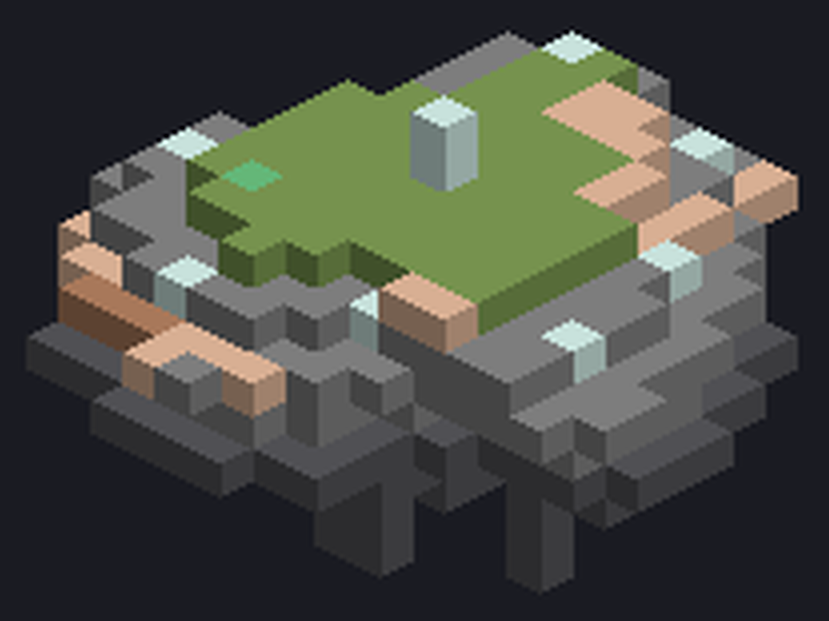
What is on one
Eight layered discs of grass, stone and deepslate, with shelves that overhang the layers
below and stalactites under the keel — it reads as a floating rock, not a stack of plates. A
column of three sea lanterns marks the centre, a sign stands on the rim and the island's
name floats above it in violet: ZGM DEPOSIT 05.
Each island carries two ores. Across the twelve, all eight overworld ores appear — coal, copper, iron, gold, redstone, lapis, diamond, emerald — in 370 ore blocks. The veins start on the outside wall and crawl along it, so a quarter to five sixths of each island's ore is visible from outside. Diamond is capped at 12 blocks and emerald at 8 per island: the point is a renewable trickle, not a quarry that makes the crate ladder meaningless.
The timer
Every island refills, on its own clock, set by its rarest ore. The sign on the rim states
it as RESETS 5 MIN.
| Rarest ore | Refill |
|---|---|
| Coal, iron, copper | 5 minutes |
| Redstone, lapis | 10 minutes |
| Gold | 15 minutes |
| Emerald | 20 minutes |
| Diamond | 30 minutes |
The timer is not a wall clock. An island refills when its cooldown is done and a player is within 96 blocks (so its chunks are loaded) and nobody is within 24 (so no block appears inside a player, and a miner standing on it is not fighting the reset). A stripped island you walk away from may still be stripped when you come back. If you want it back, stay nearby — inside 96, outside 24 — and it will rebuild.
What a refill looks like
The whole 21×14×21 box is cleared, then the rock is rebuilt from the keel up in four bands, then the veins, then the lanterns, sign and marker — about three seconds, with a sound cue at each step and a beacon at the end. It is a small event rather than a silent swap, so a player who triggered it sees the island come back.
If a refill is interrupted — a restart or a /reload in the middle of the chain —
a watchdog rebuilds the island a few seconds later. That repair announces itself differently
on purpose: the beacon switches off instead of on, the message is bold amber
[REPAIR] A deposit was repaired instead of cyan, there is a conduit cue
instead of a beacon, and a burst of end-rod sparks. If you see that, the island had to be
rebuilt; nothing of yours is involved unless you built inside the box.
Do not build on one
The rebuild deletes every block in the island's box, sign and all. RESETS 5 MIN
is literal, and it applies to your bridge, your chest and your furnace too. The pads are
where a player builds; the islands are public resource nodes.
Etiquette that follows from the mechanics: do not strip an island while somebody is mining it, and do not bridge through its box. The reset is shared by everyone in the quadrant, and the timer starts from the refill, not from when you arrive.
07 The ladder
Crates and keys
Four barrels on plinths south of the dais — copper, silver, gold, diamond — and four kinds of key. There is no menu and no right-click to hook: stand against the crate's front face and drop the key. It is consumed, and the payout lands on the barrel's top.
A key only works at its own crate. Drop a silver key at the copper crate and nothing happens; you can pick it back up. Each key is a named trial key with its crate written in the lore, so the item itself tells you where it goes.
| Crate | The key is earned by | What is inside |
|---|---|---|
| Copper | Your first pad, and every advancement you complete | Bread, torches, arrows, a golden apple — plus coal, copper and iron |
| Silver | Four diamond ore, banked from what you mine — or three copper keys at the Exchanger | Iron and gold, potions, sharpness books, a diamond or two — plus iron, gold and lapis |
| Gold | One ancient debris — or three silver keys at the Exchanger | Diamonds, netherite scrap, a totem, protection books — plus gold, diamond and emerald |
| Diamond | One dragon kill — or two gold keys at the Exchanger | Netherite ingots, totems, enchanted golden apples — plus diamond, emerald and netherite scrap |
Keys are paid from vanilla statistics, not from a shop: ore mined, debris broken, dragons killed, advancements completed. The world decides what you have earned. The silver one counts ore rather than keys, so three diamond ore and a fourth is one key and the remainder is kept — nothing is lost to rounding.
Every key also carries materials — a guaranteed draw of the tier's own stock, not a chance: a copper crate always gives coal, copper or iron, silver gives iron, gold or lapis, gold gives gold, diamond or emerald, and a diamond crate always gives diamonds, emeralds or netherite scrap. The counts step up with the tier, so the roll is the lottery and this is the supply run underneath it.
Advancements pay copper keys. Every advancement in the game's tree — 121 of them, leaving out the chapter headers and the recipe unlocks — pays one copper key the first time you complete it, on top of your welcome key. Same crate, same key, whether it arrived from a pad or from killing a Wither.
The Exchanger trades keys up. A villager stands at the east end of the
row, name and rates floating above it: 3 copper → 1 silver, 3 silver → 1 gold,
2 gold → 1 diamond. Right-click it — or type /exchange — and the
three rungs appear in a menu; click the one you can afford. A key is spent the moment you
click and the next tier arrives in your inventory.
Trading up is deliberately a little lossy. A silver crate is worth roughly 2.7 copper crates, so three copper keys are worth more than the silver key they buy — you are paying a small premium for certainty instead of a roll. That keeps opening crates the better play, which is the whole point of the row. There is no way back down the ladder, and keys are never bought or sold for items: the only way into the Exchanger is keys you earned.
The diamond rung has a second route, not a shortcut
The dragon fight is not switched on yet, so the diamond crate used to be the one nobody could open. Two gold keys at the Exchanger now reach it: that is nine silver keys, or twenty-seven copper keys, and the crates you gave up to get there were worth more than the diamond crate is. It is a way to convert a long copper run into one big opening — not a way to skip the fight cheaply.
The copper key arrives when your pad is recorded, so a new player has one opening waiting without mining anything. If your inventory was full at that exact moment, tell us in the Discord with your site number and we will sort it out.
08 The end of the ladder
The dragon
The lobby is built around an arena, and a dragon is held above it every tick so it cannot land on the walkway. You can see it from the gate causeways. The fight itself — the phases, a dragon you can actually damage, a drop that would make a diamond key mean something — is not built.
The lobby is adventure mode inside a barrier shell, so the arena is a thing to look at rather than a thing to try. When the fight ships, the diamond crate opens with it, and this page will say so before the Discord does.
09 Every platform
Bedrock and phones
Bedrock clients reach the same world through Geyser. Same pads, same gateways, same crates, same timers — it is one server, not a second one.
- Two fields, no name lookup. On a phone or console, the server address
is
play.zgmc.onlineand the port is19132. Bedrock cannot read a port from a name the way Java can. - Your name arrives with a dot. Floodgate prefixes Bedrock accounts, so
the whitelist sees
.YourName. Apply with the gamertag you actually play on; the prefix is added server-side. - The first join is often refused. That failed attempt is how the server learns your account. Try again before assuming you were not added.
- Chat shows
[Not Secure]. That is Geyser, not a warning about your account, and it is the same for everybody on Bedrock. - Floating text reads smaller. The gate names, captions, island names and the dragon banner are text displays; they render, but a phone will make you squint. The signs still work.
10 The alpha
House rules
Sixteen slots, sixteen pads, one shared map. The alpha exists to find out whether the loop is fun, which means it is allowed to change under you.
- There is no economy. No shop, no ranks, no vote, no cosmetics, and nothing bought or sold between players. The one trade on the server is the Exchanger's — keys for keys, walked up the ladder. Crates are paid for with things you do in the world.
- There is no claim protection. Your pad is recorded as yours for gateways and allocation; the blocks are not locked. Do not take from somebody's pad or chest, and do not build through a gateway.
- Deposits are public. Do not build on one, and do not strip one somebody is mining. The island comes back; your chest does not.
- The world is disposable. Growing from 16 pads to 32 is a wipe and a regenerate, announced in advance — your home is a site number, so renumbering would strand people. Nothing in the alpha is promised to survive into beta.
- Bugs go to the Discord. A screenshot and the site number solve most reports before anybody logs in.
11 Fixes
When something goes wrong
| Symptom | What it means | What to do |
|---|---|---|
| “All … pads are taken or in use” | Four claimed or occupied pads in that quadrant. | Wait, or use another gate. The message repeats at most every three seconds. |
| No kit on arrival | The kit is once per player and this account already had one. | Tell us your site number in the Discord; a second kit is an admin decision. |
| A key does nothing | Wrong crate, or the key is not in the crate's drop box. | Stand against the front face of the matching crate and drop it there. Pick the key back up and try again. |
| An island is bare | The cooldown is done but nobody has been near enough to load its chunks. | Stay within 96 blocks but outside 24 and it rebuilds; the sign says how long. |
| An island vanished, then returned with amber text | A refill was interrupted and the watchdog repaired it. | Nothing to do. The beacon stays off and the message starts with [REPAIR] so the two cases cannot be confused. |
| I died and lost my build | Your pad and everything on it persist; death only moves you. | Take a gateway back. If the loss was on a deposit island, the reset ate it — that is the one place building is not safe. |
| I cannot connect | Whitelist, edition, or the first Bedrock handshake. | Check the port on Bedrock, try twice, then ask in the Discord with the exact error. |
| I am stuck | The gateways only run one way, lobby to pad. | Type /lobby. Your inventory and your pad are untouched, and any gateway in the lobby sends you back to it. |
Anything not on this page is worth asking about — the alpha's rules are few, but they are specific, and “is this a bug or is this the game” is the most useful question you can bring.
Still stuck? The Discord is the front door, including for bugs. The player guide covers the other half: neighbours, sharing, and who to ask.
Back to the top